RAISE GENIC: Rational antiepileptic drug selection by combining gene network and ICT analyses
The RAISE-GENIC research network aims to identify models that allow predicting the drug therapy with the best chances of success for individual epilepsy patients for an individualized selection of anti-epileptic drugs. In our sub-project, we analyze RNA expression data of drug-treated cells and DNA sequencing data of affected patients and carry out the bioinformatic evaluation of the transcriptome networks and their processing for big data and machine learning analyses.
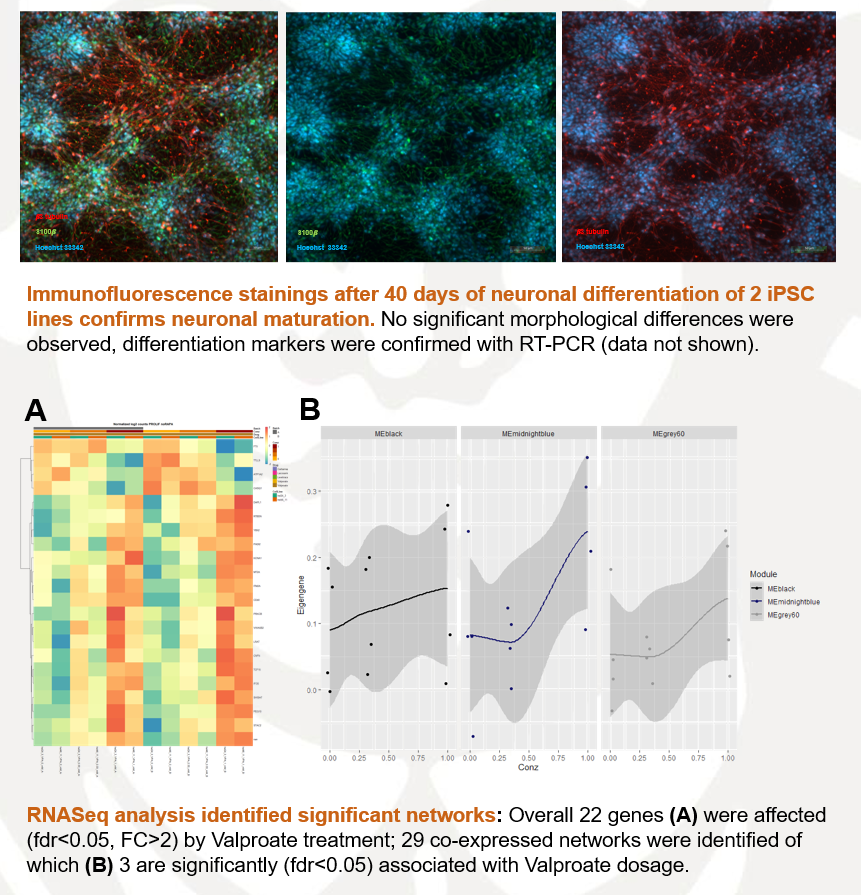
Valproate is known to activate a broad network of genes via transcriptomic regulation. We hypothesize that the transcriptomic response mediates success of valproate treatment and that thus alterations of the network properties are predictors of treatment outcome in patients with epilepsy.
We aim at developing a recommendation system for Valproate, integrating patients’ genetic information and the drug’s transcriptomic profile. For each patient in the study, we estimated how the genetic network properties are altered based on the individual’s mutational burden. We confirmed that alterations in network properties are significant predictors of treatment outcome, although with moderate accuracy. In addition, we identified stable subgroups.
Funding


Publications
A translational multimodal machine-learning prototype predicting valproate response in epilepsy treatment
Simeon Platte, Afsheen Kumar, Giorgia Guerini, Massimo Pandolfo, Denise Haslinger, Colin B. Josephson, Guillermo Delgado-García, Navprabhjot Kaur, Michaela-Pauline Lux, Heiko Stempfle, Chantal Depondt, Reetta Kälviäinen, Felix Rosenow, Sophie von Brauchitsch, Karl Martin Klein, Andreas G. Chiocchetti
Abstract
Objective
Epilepsy affects ~1% of the global population and often requires lifelong antiseizure medication (ASM) therapy. Valproic acid (VPA) is a commonly prescribed first-line ASM, yet only approximately half of patients achieve sustained seizure freedom. Treatment selection remains largely empirical. We aimed to develop and independently validate a multimodal predictive model to estimate response to VPA and support more individualized treatment strategies.
Methods
This cross-sectional treatment response modeling study used data from a subset of the international Epi25 cohort (Belgium, Finland, Germany). Individuals with epilepsy were included if they had received VPA monotherapy and had available genetic or clinical data. Discovery data (1965–2021, 58% female) were split into a training set (n = 196) and test set (n = 133). Independent validation was performed in a Canadian cohort (2021–2022, n = 156, 40% female). The primary outcome was binary VPA response. Responders achieved ≥12 months of seizure freedom attributed to VPA; nonresponders had >50% seizure recurrence or discontinued VPA due to inefficacy, adverse effects, or unclear reasons. The predictive algorithm integrated features derived from common and rare variants in VPA pharmacokinetic and pharmacodynamic genes, in vitro neuronal VPA response measures, and clinical features. Model performance was assessed using accuracy, predictive values (negative predictive value [NPV]/positive predictive value [PPV]), and area under the curve (AUC).
Results
In the independent validation cohort, the multimodal classifier achieved a balanced accuracy of 63% (95% confidence interval [CI] = 52%–73%), NPV of 70% (95% CI = 51%–85%), PPV of 60% (95% CI = 46%–72%), and AUC of .73 (95% CI = .63–.83). Models restricted to single or dual data modalities showed consistently lower predictive performance.
Significance
This proof-of-concept study demonstrates that integrating genetic, cellular, and clinical data enables prediction of VPA treatment response with clinically meaningful accuracy. Although not yet ready for clinical application, this approach supports the feasibility of biomarker-informed ASM selection and may ultimately reduce time to effective seizure control.